Posts

Does a sustainable approach is working?

 Over the past few years, there has been a growing global focus on sustainability and the need to adopt a more sustainable approach to our way of life and business practices. However, the question that arises is whether this approach is actually working, or whether are we simply paying lip service to the idea of sustainability without making any real changes? The answer is not a straightforward one as while there have been instances of progress made in certain areas, such as renewable energy and waste reduction, there are still many challenges and obstacles that must be overcome to achieve a truly sustainable future.  In fact, research indicates that companies that prioritize sustainability tend to outperform those that don't. Here are a few reasons why:  Cost savings: One of the key benefits of sustainable business practices is cost savings. By reducing energy consumption, implementing waste reduction programs, and improving supply chain efficiency, companies can save m...
KPI Finding for ESG Reporting: A Guide for Businesses

 ESG (Environmental, Social, and Governance) reporting has gained immense importance in recent years, with stakeholders like investors, customers, and employees showing an increased interest in a company's ESG practices and performance. ESG reporting enables companies to communicate their sustainability efforts, display their dedication to responsible business practices, and offer transparency to stakeholders. One of the crucial components of ESG reporting is the identification and measurement of Key Performance Indicators (KPIs). KPIs are specific metrics that enable companies to track progress towards achieving their sustainability goals. They provide a framework for measuring and reporting a company's ESG performance, highlighting areas that need improvement. Here are some steps that businesses can follow to identify relevant KPIs for their ESG reporting: Identify Material Issues: The first step in KPI identification is to determine the material issues that are relevant to t...

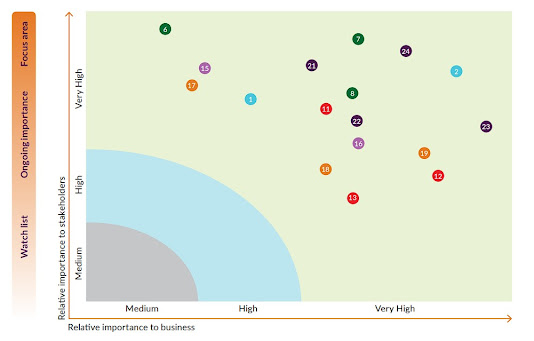
Materiality Matrices Assessment for ESG reporting

Image
 As environmental, social, and governance (ESG) issues become increasingly important to investors and stakeholders, companies are being held accountable for their sustainability performance. ESG reporting is a means for companies to disclose their sustainability performance, goals, and strategies to stakeholders. One way to determine what to include in ESG reporting is through materiality assessments and materiality matrices. A materiality assessment is a process of identifying ESG issues that are most relevant to a company's business and stakeholders. Materiality assessments are important because they enable companies to focus on issues that are most significant to their sustainability performance and to allocate resources accordingly. Materiality assessments typically involve a stakeholder engagement process to identify issues that are important to stakeholders and a business impact analysis to determine the relevance of the issues to the company's business operations. Once a...

How benchmarking is done & its importance

Image
As sustainability becomes an increasingly important focus for companies and organizations, benchmarking has emerged as a popular tool for measuring and improving sustainability performance. Benchmarking involves comparing an organization's sustainability performance against established sustainability metrics and best practices. This process can include measuring a variety of sustainability metrics, such as energy use, greenhouse gas emissions, water consumption, waste management, and social impact. Benchmarking is important for sustainability because it enables organizations to identify areas where they can improve their sustainability performance and set achievable goals for improvement. By comparing their sustainability performance against best practices, organizations can determine where they stand relative to others and identify best practices to adopt. Additionally, benchmarking provides a basis for evaluating progress over time, as organizations can track their sustainabilit...

How data is affecting human psychology

Data is transforming the way humans interact with the world and with each other. The vast amounts of data generated by our online activities are being used to shape our behaviour and influence our decisions. This has created a profound impact on human psychology, affecting everything from our perceptions and attitudes to our emotions and actions. One of the most significant ways data is influencing human psychology is through targeted advertising. Advertisers can use data to create highly personalized ads tailored to individual preferences, interests, and behaviours. By showing ads that are more relevant and appealing to individuals, advertisers can influence their attitudes and behaviours, ultimately driving sales. Another way data is affecting human psychology is through social media. Social media platforms collect vast amounts of data on their users, including their likes, comments, and shares. By analyzing this data, social media companies can create personalized feeds that show us...

Is data colonization a kind of neo-colonization?

In recent years, the term "data colonization" has gained traction to describe the practice of powerful entities exerting control over data generated by individuals and less powerful countries. This raises questions about whether data colonization is a form of neo-colonization, a concept that describes the process by which powerful nations exert economic, political, and cultural control over less powerful nations. Neo-colonialism originated in the 1960s and was first used by African nationalist leaders to describe the continuation of colonial economic, political, and cultural domination after formal decolonization.  According to neo-colonial theory, powerful Western nations use economic and political influence to maintain control over former colonies, allowing them to continue to extract resources and wealth from these countries. On the other hand, data colonization is characterized by powerful entities exerting control over data generated by individuals and less powerful coun...